By: Nazira Maqbool
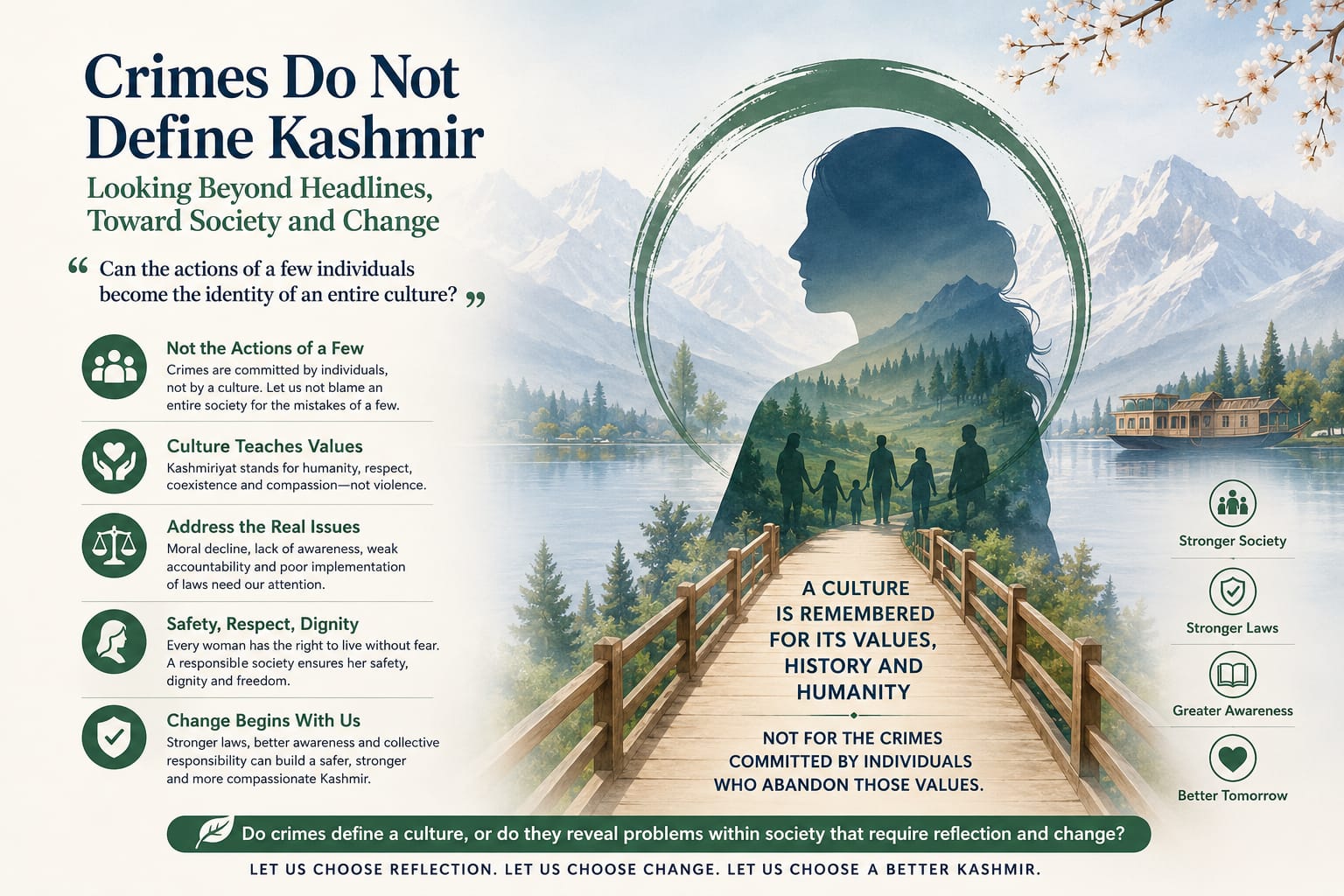
Crimes Do Not Define Kashmir
Looking Beyond Headlines, Toward Society and Change
“Can the actions of a few individuals become the identity of an entire culture?”
Recent incidents of crime in Kashmir have deeply disturbed society and raised serious concerns, particularly regarding women’s safety. With every such incident, a familiar debate resurfaces. Questions begin to emerge around Kashmiriyat, cultural values, and the identity of society itself. But an important question demands attention: Can the actions of a few individuals define the identity of an entire culture?
Every society across the world faces challenges. No community remains unchanged; values, lifestyles, and patterns of interaction evolve with time. Kashmir, too, is experiencing social transformation. The influence of social media, changing lifestyles, and evolving social dynamics have reshaped how people connect and live. Change itself is not the issue. The concern arises when moral responsibility, empathy, and respect for others begin to decline.
The most painful reality is that innocent people often become victims of someone’s anger, selfishness, violence, or lack of humanity. Recent incidents in Budgam have shaken many people and reignited concerns regarding women’s safety and social responsibility. Such events leave behind not only pain for families but also fear and difficult questions for society as a whole.
After such incidents, many voices immediately ask: “What happened to Kashmir?” or “What happened to Kashmiriyat?” However, reducing these incidents solely to culture may overlook deeper social realities that also require attention. Society must reflect on issues such as moral decline, awareness, accountability, women’s safety, social influences, and stronger implementation of laws.
Culture alone cannot be blamed for crimes because culture itself teaches values, humanity, and coexistence. Crimes emerge when individuals abandon these principles. Holding an entire society responsible for the actions of a few creates division, while ignoring deeper issues delays solutions.
Women deserve to walk freely without fear. Laws must be implemented effectively, awareness should be strengthened, and society must create an environment where potential offenders fear the consequences of their actions before even thinking of committing such acts.
As we discuss these painful incidents, one question remains:
Do crimes define a culture, or do they reveal problems within society that require reflection and change?
Because a culture is remembered for its values, history, and humanity — not for the crimes committed by individuals who abandon those values.
The author, Nazira Maqbool, is a student of Economics at Cluster University Srinagar.